Chipotle already has Starbucks’ best partners. It didn’t cost $55 billion.
Part 3 of 3: The international playbook and Wall Street’s verdict
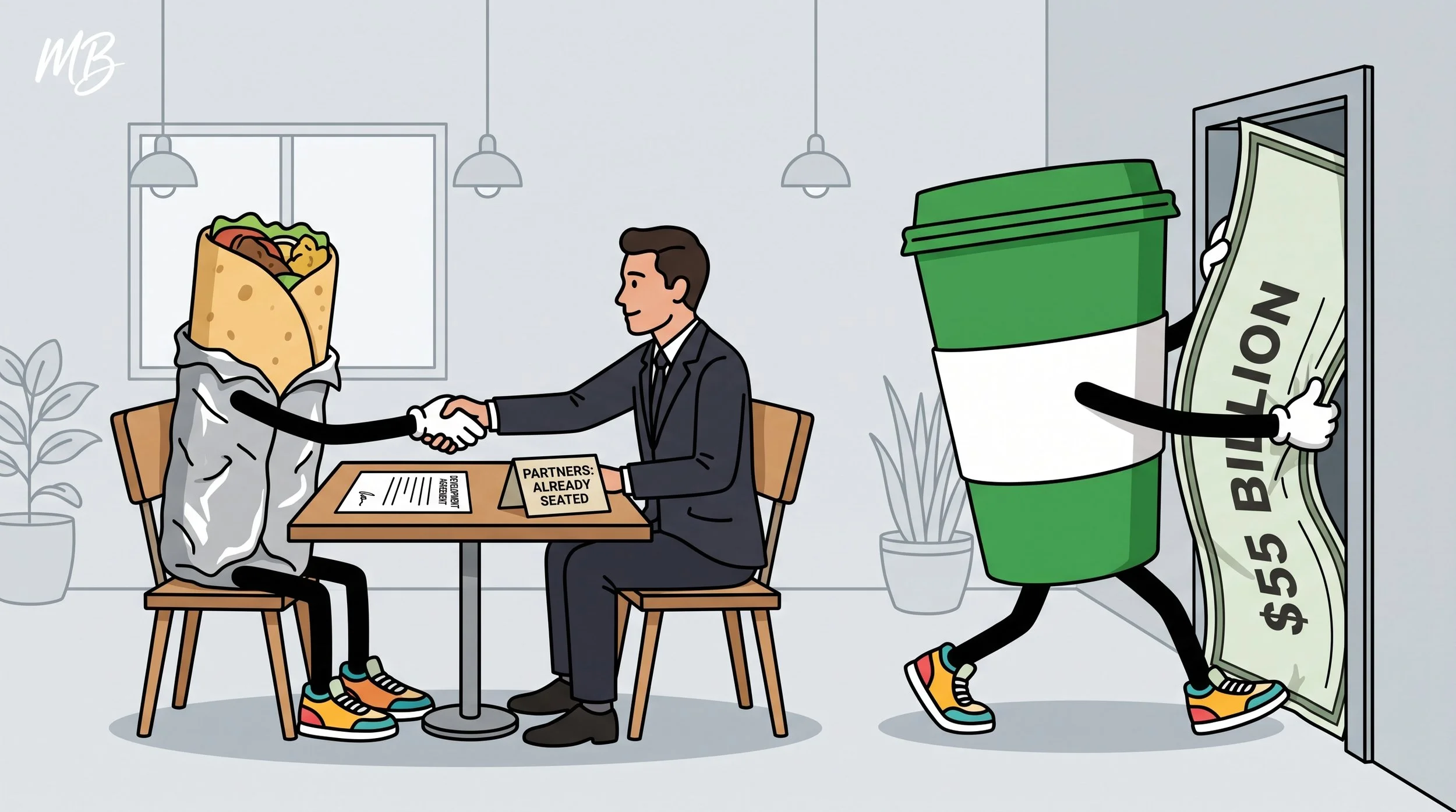
Chipotle already has development agreements with Starbucks’ key international partners, Alshaya and Alsea. No $55 billion is required.
In Part 1, I argued that Chipotle’s problem is the line. In Part 2, I argued that the synergies sit in the head office while the money sits in the kitchen.
That leaves the argument bankers lead with: international.
On paper, it’s the strongest case for the deal. Starbucks has around 41,000 stores worldwide and a network of operating partners in dozens of countries. Chipotle has about 4,200 restaurants, almost all in the US. Plug one into the other, and Chipotle goes global.
It’s a strong argument until you look at who is already at the table.
The partners are already in the room
Chipotle has signed three international partners in the last three years.
Alshaya, for the Middle East, in 2023.
Alsea, for Mexico, in 2025. Their first Chipotle opened in July near Monterrey, and Mexico City is planned for next year.
SPC Group, for South Korea and Singapore, in 2025. Korea is due to open later this year.
Now look at who runs Starbucks in those regions.
Alshaya has operated Starbucks across the Middle East for more than twenty years. Alsea runs Starbucks in Mexico, much of Latin America and parts of Europe.
In other words, the two most valuable relationships a takeover would “bring” to Chipotle are relationships Chipotle already has. It didn’t need a $55 billion deal to get them. It needed a development agreement.
And where Chipotle didn’t follow Starbucks, in Korea, it chose a different partner on purpose. SPC is the group that brought Shake Shack and Dunkin’ to Korea, and it knows how to launch American brands there.
There’s a deeper point too. Starbucks itself is handing more of its international business to partners. This year it sold control of its China business, around 8,000 stores, to the investment firm Boyu Capital, keeping 40%. The international “platform” a buyer would be paying for is increasingly a set of partner relationships. Partner relationships aren’t exclusive. Chipotle can sign its own, and it already has.
Chipotle’s real international problem
If partners and landlords were the barrier, Chipotle would already be global.
It isn’t, and it has had plenty of time. Chipotle opened in Canada in 2008, London in 2010, Paris in 2012 and Germany in 2013. More than fifteen years later, it has around 30 restaurants in Europe.
I had a front-row seat. In 2010, I was running operations at Chilango, a London Mexican brand, when Chipotle arrived.
Their first site, on Charing Cross Road, was a smart choice. It’s still open today. Then came a handful more in quick succession, mostly in the West End, on heavy rents and heavy key money. The moves into France and Germany stalled. Chipotle’s own European director said at the time that fast growth was “very risky”, and the next decade proved him right. By 2020, Chipotle had just eight restaurants in the UK, all in London.
The issue wasn’t the brand or the food. It was the approach. There was a “we can run this from the States” mentality, with very little local experience or relationships. Senior leadership changed every few years. It took years to adapt the kitchen for Europe, moving away from gas and fryers and into smaller sites. Meanwhile, homegrown brands had got there first. Tortilla had been open since 2007. I was across town, building Chilango.
Chipotle also became another wealthy client for London’s concierge economy: the agents, advisers and consultants who help American brands land here. I’m part of that economy myself, and there’s nothing wrong with it. When a company has a knowledge gap, paying to fill it is normal business. The mistake is renting local knowledge instead of building it.
So what changed?
Someone moved. In 2021, Brian Niccol, then Chipotle’s CEO, backed a fresh push into the UK. The following year, a Chipotle veteran of more than twenty years relocated from the US to London to run it. He admitted the UK business had drifted: the menu had fallen behind and the operation needed guidance. He fixed it on the ground. Ten openings followed in eighteen months. UK sales jumped from £17.9 million to £26.2 million in a single year. 2025 was Chipotle’s best UK year on record, and it plans to grow its UK estate by 20% this year.
Notice what the turnaround took. Not a bigger parent company. An experienced operator, living in the market.
A takeover run from Seattle would be the opposite instinct with a bigger cheque.
What actually decides whether a brand travels
I’ve spent most of the last fifteen years taking American restaurant brands abroad. In my experience, four things decide whether a concept travels. A partner network helps with only one of them.
1. The supply chain. At Burger & Lobster, I helped set up the supply chain to fly live Canadian lobsters and Australian beef to our franchise partners in the Gulf.
We opened in Jeddah during Ramadan. Once a live lobster comes out of its holding tank, you have roughly 48 hours. Most leave on flights from Boston Logan. Ours landed in Jeddah just as the evening prayer began, when the customs officers had gone home to break their fast with their families. We needed a stamp from the Ministry of Agriculture. They said they’d clear the shipment the following night. We told them the lobsters would start dying by 8am.
Mr. Ziad, our local partner, knew exactly who to call. The lobsters were released at 8:30 the next morning. I’ve never forgotten it.
Finding a partner is easy. Finding one with real local influence, overnight, during Ramadan, is priceless. And getting a perishable product to the restaurant, at the right quality, every single week, is the business.
Now apply that to Chipotle. Its menu depends on fresh avocados, specific chiles and proteins raised to its own standards. Avocados are expensive enough in California, where they actually grow. Add an 8,000-mile journey to the Gulf, and a fruit that has to arrive ripe, not rock-hard and not brown, and the cost of a single bowl of guac changes completely. That’s the problem Chipotle’s partners face in every new country, and Starbucks’ coffee buyers can’t solve it.
2. Re-engineering the operation. When I led Wingstop into Europe, the American model didn’t work as it was. We brought in new cooking technology and kitchen display screens, and stripped out every moment that didn’t add value. It was the same thinking as New York. There, we rounded prices to the nearest quarter. In London 2017, we went cashless.
Average ticket times, from order placed to food in the guest’s hands, fell by half. I led that work, and I was lucky to have ambitious partners who backed it. By early 2020, Wingstop’s CEO was telling investors that its “enhanced speed of service cooking platform” was part of the engine behind its international growth.
No head office hands you that. It’s built in the kitchen, by people who understand why the original model works and what has to change for a new market.
3. The cost of the box, and the time it takes to fill it. In the West End, Chipotle’s restaurants could be busy. Elsewhere, Londoners didn’t yet know the brand. Chipotle itself has said UK sites took longer to build their sales because of that. But the rent, the key money (the upfront premium London charges for a prime site) and the cost of a US-style kitchen arrived in full on day one. That gap between cost and sales is where international growth stalls. Closing it means redesigning the kitchen, rethinking the size of the site and building awareness one neighbourhood at a time. That work is done locally.
4. Then, and only then, the partner. This is the one area where Starbucks’ relationships could help. And as we’ve seen, Chipotle already has the partners that matter.
To its credit, Chipotle seems to have learned. When the Mexico restaurant opened, its business development chief said the focus was on “opening one great restaurant and learning”. That’s the right instinct. One great restaurant teaches you more than a thousand-store licensing network ever will.
Wall Street’s verdict
So what did the market make of it?
When the report came out, Chipotle’s shares rose as much as 8% during the day. Starbucks’ shares fell around 4% before recovering to close roughly flat.
Read those numbers like an operator reads a P&L.
If investors believed Starbucks was about to buy Chipotle at a normal takeover premium of around 30%, Chipotle’s shares would have jumped much more than 8%. A single-digit rise suggests the market sees roughly a one-in-four or one-in-five chance of a deal. That’s my estimate, but the direction is clear. The market doesn’t believe it yet.
Starbucks investors were more direct. A short dip, then a shrug. The message was: show us the turnaround first.
The sharpest question came from Seaport Research. If the savings aren’t the reason, what would Niccol do differently from the people running Chipotle today?
Any operator who has read this series knows the answer. He’d go back to the line.
The real verdict comes later this month
Starbucks reports its full-year results and gives its outlook for next year in the coming weeks. Chipotle reports around the same time.
Those two reports will say more about this deal than any rumour. If Starbucks shows its turnaround is still accelerating, a bid looks like a distraction from a winning plan. If Chipotle shows its traffic recovering, the price goes up and the argument for buying gets weaker.
Either way, the numbers that matter will come from restaurants, not from bankers.
What a smarter deal looks like
For investors reading this, here is the simplest way I can put it.
If the goal is international growth for Chipotle, the tool is a licence, not a merger. Chipotle is already using it.
If the goal is fixing Chipotle in America, the tool is an operator. Someone who knows what the line should feel like at 12:30, and won’t accept anything less.
Neither one costs $55 billion.
Closing the series
Over three weeks, I’ve looked at this deal from three angles.
The leadership: Chipotle’s problem is the line, not the brand.
The kitchen: the synergies sit in the head office, but the money sits in the kitchen.
The world: Chipotle already has the partners it needs. What it needs abroad is what it needs at home: great restaurants, one at a time, run by people who know the street they’re on.
Twenty years ago, I stood on the floor of the New York Stock Exchange and watched Chipotle go public. What made it worth buying then is what would make it worth buying now. Not the app, the head office or the global footprint.
The front line.
“If the goal is international growth, the tool is a licence, not a merger. If the goal is fixing Chipotle, the tool is an operator. Neither costs $55 billion.”
Investors and operators: if you had $55 billion and Chipotle’s problems, where would you spend the first dollar?
Michael Baglieri
The synergies are in the head office. The money is in the kitchen.
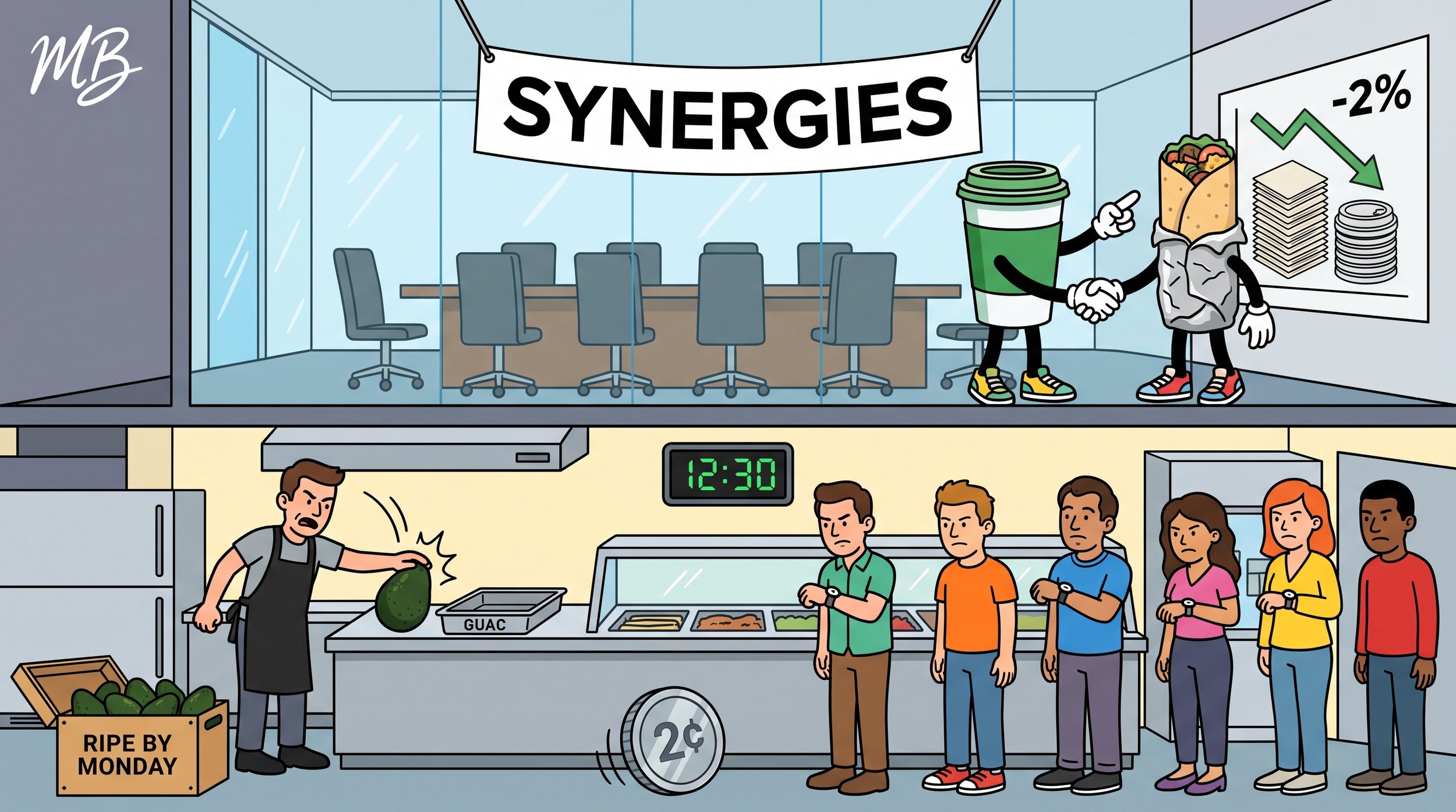
You don’t fix a margin problem with a bigger head office. You fix it at 12:30, on the line.” - Michael Baglieri
Part 2 of 3: The operational and unit economics reality check
In Part 1, I argued that Chipotle’s problem is the line, not the brand.
This week, I want to follow the money.
When bankers talk about a deal like Starbucks buying Chipotle, they talk about “synergies”. Operators should translate that word. It means: what gets cheaper, or what sells more, because two businesses sit under one roof.
So let’s go looking. Restaurant by restaurant. Dollar by dollar.
Start with one dollar
Take every dollar a Chipotle restaurant brought in during the second quarter.
About 30 cents went on food, drink and packaging, up from 29 cents a year earlier.
25 cents went on the crew.
After rent, utilities and everything else, the restaurant kept 25.2 cents. A year ago, it kept 27.4.
Two cents doesn’t sound like much. Across a business taking in more than $3 billion a quarter, it’s roughly $70 million every quarter that used to stay in the restaurants.
I know where those cents hide, because I used to chase them by hand. In my day, we built every restaurant’s weekly P&L ourselves in Excel. Three products drove more than half of our food cost: meat, dairy and avocados. And the fastest way to wreck a week was chicken. It’s fresh. If you got your sales forecast wrong or lost track of your stock, you binned two or three cases, and your food cost for the week was gone.
Thankfully, the tools are better now. The physics of fresh food isn’t.
So here is the only test that matters for any deal: does it put those two cents back?
What a merger can actually buy cheaper
Let’s be fair to the bull case. There are real savings.
Packaging. Cups, lids, bags, napkins. Both companies buy mountains of them. Combine the orders and the price comes down.
Technology. One app platform, one payments system, one data team instead of two.
Head office. Chipotle spent $176 million on general and administrative costs in the second quarter. That is the cost of running the company above the restaurants. Some of it overlaps with Starbucks.
Landlords. A company with 45,000 restaurants worldwide gets a better hearing than one with 4,200.
All real. Now let’s size them.
Say a combined company cut a quarter of Chipotle’s head-office cost. That’s roughly $175 million a year. Good money. But against a likely price of around $55 billion, that saving on its own would take more than 300 years to pay back.
And even if you made that cut, it wouldn’t touch the two cents. Head-office savings make the company’s overall numbers look better. They don’t put a penny back into the restaurant’s P&L. They hide the leak. They don’t fix it.
That leaves the other 30 cents: what goes on the plate. Packaging is the easy part, and the small part. The big part is beef, chicken, avocados, rice, beans and cheese. Starbucks doesn’t buy any of those at a scale that moves the price.
Coffee travels. Guacamole doesn’t.
Starbucks is built on a dry commodity. Green coffee is bought, roasted in its own plants and shipped in bags that last for months. Its supply chain is built for scale and distance.
Chipotle is built on fresh. Raw proteins. Produce. Avocados that go from rock-hard to brown in a few days. The skill isn’t buying cheap. It’s buying consistently, and turning it into food on the line before the first guest walks in.
In New York, most of our restaurants took three deliveries a week. Space was tight and volumes were huge. If your walk-in wasn’t nearly empty when the truck arrived, you had nowhere to put 20 cases of fresh chicken. Managing a fresh supply chain isn’t a purchasing exercise. It’s something you do in the restaurant, every day.
And sometimes, nature makes the decision for you.
In January 2007, a hard freeze hit California and wiped out large parts of the avocado crop. Our market received hundreds of cases from other sources, but they were as green as could be. Impossible to mash. Head office and our support team had done everything they could. Ripe fruit wasn’t coming until after the weekend.
I remember hanging up the phone thinking we might have to take guac off the menu.
Then I walked into a shiny new Whole Foods on Houston Street and found a mountain of ripe avocados. They had moved early on Mexican supply. I left a handwritten note for the head of produce and met him the next morning.
“How many cases do you need?”
“120.”
“I can give you 40 today. I’ll have 80 delivered here tomorrow.”
I spent that morning driving around Manhattan dropping off avocados like a yellow-taxi Santa Claus. The next day, all three New York area managers were at Whole Foods, loading up. We served guac all weekend.
That’s what a fresh supply chain looks like at street level. A barista who runs low on vanilla grabs another bottle off the rack. A burrito line that runs out of ripe avocados damages the guest experience..
Starbucks’ muscle in coffee gives Chipotle nothing on beef or avocados. And those are what’s squeezing Chipotle’s margin right now.
The labour model doesn’t transfer either
Niccol’s Starbucks turnaround added labour. He put more people in stores to get drinks out faster. It worked: North American same-store sales were up 8.1% in its most recent quarter, to June.
Chipotle’s crew already takes a quarter of every dollar. Headcount isn’t the problem. Deployment is.
At Chipotle, everything was married to the clock. Position charts. Food production schedules. Break times. Who’s on Tortilla 1 at 11:45, who’s on the grill at 12:15, who’s on break at 2:30. Get the timing right and the same crew does more. Get it wrong and no amount of extra labour saves you. That is management, shift by shift, and no parent company does it for you.
The risk nobody is pricing
Starbucks has a union. Its baristas rejected the company’s contract offer in April. Chipotle’s crews are largely non-union. Put both brands under one roof and organising at Starbucks becomes a conversation at Chipotle. That’s my reading, not a forecast. But any board would have to weigh it.
Loyalty: big numbers, different habits
Starbucks Rewards started the year with 35.5 million active US members, driving nearly 60% of US company-operated sales. Chipotle Rewards has 23 million active members after relaunching in April.
Put them together and you have a huge customer database. But a database doesn’t change a habit.
Starbucks’ most loyal guests come in several times a week, and many load money onto the app before they’ve bought anything. Chipotle’s regulars come in for lunch, once or twice a week. A free burrito offer in the Starbucks app might win a trial visit. It won’t turn a morning coffee habit into a lunch habit.
Frequency is earned on the line, one visit at a time.
The real estate idea is really a franchise idea
The smartest version of the bull case borrows from Yum Brands. KFC, Taco Bell and Pizza Hut run as separate brands but share real estate and back-office muscle. Niccol spent more than a decade at Yum. He knows that playbook better than anyone.
But Yum’s model works because it is almost entirely franchised. Franchisees run the restaurants; Yum runs the brands.
Chipotle owns and runs every one of its US restaurants. I’ve worked on both sides of that line: company-operated at Chipotle, franchised at Wingstop and Burger & Lobster. The difference is bigger than most people realise.
When you own the restaurant and you want to add labour to speed up the line, you have the right to do it. Almost the obligation. As a franchisor, you have to persuade a franchise partner to spend his own money because you believe a better guest experience will grow sales and pay for itself. That trust can take years to build. And with a large partner operating thousands of miles from head office, you often can’t see whether the change was actually made.
At Chipotle, I could walk from my East Village apartment to all eight of my restaurants. If I put a new hire on the chop station or on rolling, I could work alongside her for two shifts and make sure it worked. The feedback loop was instant. Our managers were in the dining rooms, talking to regulars every day. We were taught to act as if we owned the place, because we did.
That is why Chipotle’s culture and throughput were ever special. Applying the Yum playbook would mean either franchising Chipotle, which changes the business completely, or running two company-operated estates from one head office.
What about sharing sites? Starbucks drive-thrus and Chipotlanes chase the same suburban corners, and four in five new Chipotles now open with a Chipotlane. Shared site data and joint negotiations make sense. Putting two brands in one building doesn’t. Starbucks peaks at 8am and Chipotle at 12:30, but you would still need two kitchens, two crews and two sets of equipment.
You’d save on the car park.
The bill
Then there’s the cost of the money itself.
$55 billion is my estimate of the price once you add a normal takeover premium. Starbucks doesn’t have that in the bank. It already carries about $24 billion of debt.
If it borrowed half the price, and that debt cost around 6%, the interest would be about $1.6 billion a year. That’s close to what Chipotle earns in a full year. The rest would have to come from new Starbucks shares, which means every existing shareholder owns a smaller slice.
In restaurant terms, it’s like buying a second site with a loan whose payments eat all of that site’s profit, then hoping the savings on napkins make up the difference.
What actually puts the two cents back
Chipotle’s unit economics get fixed the way they always have.
Faster lines at peak. Prep that never runs short. Stock managed so nothing gets binned. Crews who know their positions. Managers who check the numbers mid-rush and move people where they’re needed. That is how a restaurant grows its sales without adding a single square foot.
None of that needs a $55 billion parent.
The synergies in this deal live in the head office. The money lives in the kitchen.
“You don’t fix a margin problem with a bigger head office. You fix it at 12:30, on the line.”
Operators: when your restaurants lose two cents of margin, where do you go looking first?
Next in this series: Part 3, the international playbook and Wall Street’s verdict.
Michael Baglieri
Brian Niccol doesn’t need Chipotle. Chipotle might need Brian Niccol.
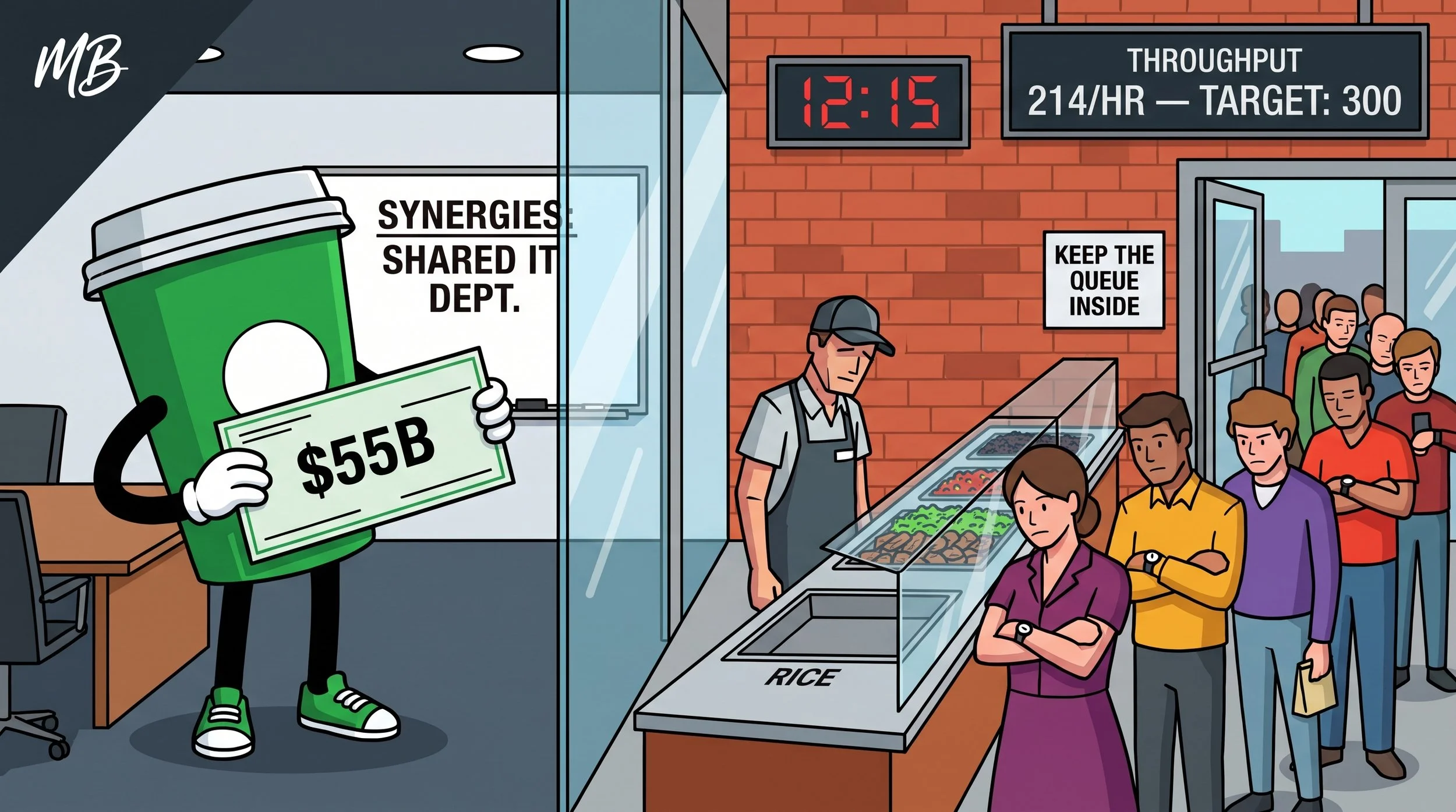
The front line is key. Turnarounds are won on the front line, not in the boardroom. Michael Baglieri
Part 1 of 3: The strategic rationale and the Niccol factor
I was on the floor of the New York Stock Exchange the day Chipotle went public in 2006.
Twenty years later, the man who rebuilt it might be the one to buy it.
Maybe.
Last week, the Financial Times reported that Starbucks has worked with advisers on a possible bid for Chipotle. Be clear about what that means. There are no talks and there is no offer. Chipotle says it hasn’t received a bid. Starbucks says it doesn’t comment on rumours and is “laser-focused” on its own turnaround.
So why write about a deal that may never happen?
Because the rumour tells us something true, whether or not anyone signs anything.
Two companies, trading places
When Brian Niccol left Chipotle for Starbucks in August 2024, most people saw a CEO move. In hindsight, it was a transfer of the one thing both companies needed most.
Since then, Starbucks shares are up about 20%. Chipotle’s are down about 45%.
At Starbucks, more customers are coming through the door. Transactions were up 4.2% last quarter. At Chipotle, same-store sales haven’t grown more than 2.2% in any of the last six reporting periods, and half of those were negative.
One brand found its operator. The other lost him.
Chipotle is a line business
I spent seven years at Chipotle and opened the New York market. If there is one thing I know about that business, it is this:
Everything comes down to the line.
The brand, the margin and the share price all depend on how many guests you get down the line between 12:00 and 2:00. When you hit your number, the restaurant prints money. When you don’t, nothing else you do will save the P&L.
When we opened New York, we knew the line had to pay Midtown rent. That meant chasing 300 transactions an hour.
The rule was simple: keep the queue inside the building. If more than five people were standing outside the front door, we knew the number of guests who looked at the line and walked away would triple. At some sites, like Bowling Green on a rainy day, the queue would wrap around the entire inside of the restaurant. That was fine. Inside meant they were staying.
You could feel the difference the moment you walked in.
When the line was jamming, the guests’ faces were full of smiles and anticipation for their moment at the front. When it was slow, you felt the tension before you saw anything: crossed arms, stern faces, people checking their watches. You dropped your backpack in the office and jumped into the kitchen to find the kink.
It was never a mystery. Someone had called out. Someone had fallen behind on rice. The dish area had blown up and there weren’t enough pans or spoons.
You don’t hit 300 an hour by asking people to work faster. You get there by removing every second that doesn’t need to exist.
So we changed the experience to fit the city.
We priced for speed. We reset every menu board price so that, once tax was added, the total landed on .25, .50 or .75. Cashiers only had to deal with bills and quarters. No fishing for nickels and dimes while the line backed up to the door.
We protected the line. We added a position whose only job was to keep the line stocked. Nobody serving a guest ever had to disappear into the kitchen to refill the steak. The crew’s attention stayed where it belonged: on the person in front of them.
We taught the guest our language. We trained customers to order the way we called it internally: “Burrito. Chicken. Black.” Before long, New Yorkers were ordering in our shorthand without thinking about it. Every order arrived in the sequence the line was built to make it.
We built for the orders you couldn’t see. Every New York site had a second make line. Back then it handled fax orders. Yes, fax. Today, that second line handles digital orders.
Managers checked the throughput numbers several times during each rush, and sometimes swapped positions after the first hour. Working Tortilla 1 through the full lunch rush is no joke. By 2:30 on a Friday, everyone was on the phone comparing results. If a site broke its throughput record, by 3:30 the crew was eating pizza or ice cream.
None of that was strategy. It was operations. And it worked because everyone in that building understood one thing.
The front line is key.
Anyone who has worked at Chipotle will smile at that line. It was a pillar of the culture. Everything else served the people on the line, and the people on the line served the guest.
Throughput is not part of the product at Chipotle. Throughput is the product.
Now look at the numbers through that lens
Average sales per restaurant in the second quarter slipped from $3.14 million to $3.10 million, even though sales across the company grew. Each restaurant kept 25.2 cents of every dollar, down from 27.4 cents a year earlier. Beef costs more. Labour costs more. And the line isn’t moving fast enough to pay for either.
That is not a brand problem. Customers still know exactly what Chipotle is.
It is a line problem.
What Niccol actually did at Starbucks
Here is the irony. Niccol didn’t fix Starbucks with a big strategic move. He fixed it on the floor.
He put more people in the stores. He cut the menu. He worked out how to get drinks into customers’ hands faster. That’s the unglamorous stuff every operator reading this knows by heart, and it worked.
The same logic applies at the counter. Baristas mark and call drinks in a set order: size, milk, shots and so on. The guest who orders in that same order saves a second or two at the till and is less likely to get the wrong drink. Starbucks’ app now does this automatically, because every mobile order arrives already in the right sequence. It is what our menu boards did in New York, rebuilt for a phone.
Which is exactly why a takeover doesn’t fix Chipotle.
A barista bar and a burrito line share almost nothing: different kitchens, different suppliers, different training and different peaks.
Both are high-throughput businesses, but the labour works in opposite ways. At Starbucks, most of the work happens at the moment of the order: the drink doesn’t exist until the guest asks for it. At Chipotle, most of the work happens before the doors open. The chopping, the marinating, the grilling and the guac are done hours ahead, so the line can assemble in seconds. One business is built at the till. The other is built in the prep kitchen at 8am. You can’t run both from the same playbook.
You cannot run Chipotle’s lunch rush from Starbucks’ headquarters. A holding company does not move a burrito down the line any faster.
Digital orders don’t change that. They’re now 38% of Chipotle’s sales, and most of them run down a second make line, the same idea we built for fax orders twenty years ago. But both lines draw on the same grill, the same rice and the same pans. When prep falls behind, both lines stall.
The parts that genuinely combine are real: leverage with landlords, Starbucks’ international partner network, and a shared app and back office. But none of them fixes the engine. About 97% of Chipotle’s restaurants are in the US, and every one of them still depends on getting people down the line at 12:15. Chipotle also already works with two of Starbucks’ biggest international partners. More on that in Part 3.
You don’t pay $55 billion for a shared IT department. That would be more than three times the biggest restaurant deal in history.
Watch what Chipotle’s board is doing, not what it’s saying
Two details are worth noticing.
First, Chipotle bought back $630 million of its own stock in the second quarter at a post-split average of $32.55 a share. That is almost exactly where the stock was trading when the deal report landed. The board has been voting with its own money on what the company is worth.
Second, in September Chipotle added the former CEO of KFC to its board. Before that, its chairman was the only director with real restaurant experience.
Those are the moves of a company that knows what it lost.
The real risk for Starbucks
For Starbucks, the danger isn’t the debt. It’s the timing.
This leak landed weeks before Niccol presents his first full-year outlook as a proven turnaround CEO. Every investor in that room will ask the same question:
If the coffee turnaround is working, why are we looking at burritos?
That question costs nothing to ask. Answering it poorly could cost Niccol the credibility he’s spent two years rebuilding.
What this means for the rest of us
Strip away the deal talk, and you’re left with a lesson every multi-site operator should take seriously.
The most valuable asset in either company isn’t the real estate, the app, or the loyalty programme. It is leadership that knows what the line should feel like at peak, and that won’t accept anything less.
Chipotle had that. It let it walk across the street.
You win turnarounds on the front line, not in the boardroom.
“The front line is key. Turnarounds are won on the front line, not in the boardroom.”
If you’ve run a line at peak, what’s the first thing you’d fix at Chipotle tomorrow morning?
Michael Baglieri

The Sovereign Restaurant — Blog Series - Post 6: The Sovereign Choice
While one operator sleepwalks down a smooth, well-lit corridor signposted "FREE AI ANALYTICS →" — being gently herded by smiling AI mascots — another operator stands at the fork, arms crossed, holding the deed to their own vault. The joke isn't that the first operator is stupid. It's that they're rational. And that's exactly the problem.
Six weeks ago I posted two lines on LinkedIn and left them there without explanation.
A few hundred people engaged with it. A few dozen sent messages asking what I meant. The thesis that followed — The Sovereign Restaurant — has been the most substantive thing I have published in this industry, and the response has confirmed something I suspected when I started writing it: the operators and investors who are thinking clearly about the 2030 horizon already know something is wrong. They just haven't had a framework for naming it yet.
So let me end this series with the argument I consider most important. Not the most technically interesting, not the most immediately actionable, but the one that I think will look most consequential in retrospect.
The sovereign choice is not about technology. It is about which side of a structural divide you end up on.
On one side are the operators who will, over the next 24 months, gradually migrate their operational intelligence into platforms that are offering AI analytics as a free or near-free inclusion. They will do this because it is the path of least resistance. The integrations will be clean. The dashboards will be good. The IT overhead will be lower than building an alternative. Each individual decision will look rational.
At the aggregate level, those operators will have permanently transferred their most durable competitive asset to vendors whose commercial interests are structurally misaligned with theirs. They will have analytics. They will not have sovereignty. And when the platforms move — as they will — to monetize the corpus they have built from operator data, those businesses will discover they funded someone else's intelligence layer with their own operational history.
On the other side are the operators who make a different decision. Who treat their data as an asset rather than an overhead. Who build — or procure, or contractually protect — the inference layer that sits on their own data and stays theirs. Who arrive at 2030 with a proprietary corpus that cannot be replicated retroactively, no matter how sophisticated the platform's offering becomes.
I am not pretending this is a costless choice. Building proprietary data infrastructure is harder than signing a SaaS contract. It requires investment, internal capability, and the organisational patience to treat a long-term asset as a genuine priority before its value is obvious.
What I am saying is that the window to make this choice is open right now, and it will not stay open indefinitely. The platform announcements are coming. Once the default becomes seamless enough, the friction of the alternative will increase and the commercial case will become harder to make to a board that wants simplicity.
The delivery aggregator decision looked obvious in 2005. One contract at a time, the industry built a dependency it is still paying for twenty years later.
The data sovereignty decision is being made now. In every contract renewal. Every platform onboarding. Every time someone clicks agree without reading the terms.
None of what I've written in this series is certain. The agentic discovery timeline could slip. The data monetization thesis could prove harder to execute than the logic suggests. I have tried to be honest about where the argument is speculative and where it is grounded.
What I am not uncertain about is this: the operators who treat their data as a liability will arrive at 2030 having subsidised someone else's intelligence layer. The ones who treat it as an asset will have something worth owning.
That is the sovereign choice. It is available right now.
This is the final post in the Sovereign Restaurant series. The full white paper — covering all four pillars in detail — is available [here]. If this thesis is relevant to your business and you want to discuss it further, my details are below.
— MB

The Sovereign Restaurant — Blog Series - Post 5: The Macro Lab
The Sovereign Restaurant Meta: The forward indicator for your cost base is already inside your operation. You're just not reading it yet.
There is a number sitting inside your operation right now that your purchasing team does not have.
It is not in your ERP. It is not in your supplier portal. It is not in any market report that lands in your inbox on a Friday morning. It exists only in the aggregated pattern of your own operational history — in the delivery variances, the waste events, the procurement shifts, and the menu mix changes that your sites have been recording, mostly without reading, for years.
That number is a forward indicator for your own cost base.
Here is the logic. A 50-site operator running at scale is conducting thousands of small economic transactions every week across the full food supply chain. Each of those transactions is a data point. A delivery that came in 3% above the invoice estimate. A waste event on a protein line that has happened three Thursdays running. A purchasing decision that was made at a price point that, in retrospect, preceded a supplier price increase by six weeks.
Individually these are operational footnotes. Aggregated across sites, reconciled against your own historical patterns, and read against the broader procurement cycle, they are something more useful: they are your operation telling you, in advance, where your input costs are heading.
Most operators are not reading this signal. They are receiving their cost base as a monthly surprise — discovering in the P&L review that beef moved, or that a key supplier has repriced, or that a category they thought was stable has started behaving differently. The response is reactive. The margin impact has already happened before the conversation starts.
The practical application of what I'm calling the Macro Lab is not complicated. It does not require a data science team or a proprietary algorithm. It requires a decision to structure and read the operational data you are already generating — to build the internal intelligence layer that converts your procurement history into a forward-looking view of your own cost exposure.
Done well, this lets you time your purchasing decisions rather than react to them. It lets you adjust your menu pricing ahead of the squeeze rather than in response to it. It lets you move from a posture of reactive cost management to something that resembles a considered position on your own supply chain — knowing when to lock in and when to let contracts run.
I want to be clear about the limits of this argument, because I think clarity matters more than a clean narrative.
The version of this thesis that involves selling your operational data corpus to institutional investors or FMCG partners as a commercial signal product is a genuine long-term possibility. It is also a near-term distraction that requires legal architecture, GDPR compliance, and a sales function most operators do not have and should not build right now. That is a 2029 conversation.
The 2026 conversation is simpler: use your own data to run a smarter operation. Anticipate your cost base. Make better purchasing decisions. Stop being surprised by your own P&L.
If it becomes a revenue stream later, that is the upside you never had to promise anyone.
The bin data is not waste. It is a dataset. The question is whether you are treating it like one.
Part five of the Sovereign Restaurant series. Full white paper available [here].

The Sovereign Restaurant — Blog Series - Post 4: The 70/30 Rule
The Sovereign Restaurant Meta: Your Area Manager is spending 70% of their week retrieving data. Here's what you get back when you stop asking them to.
I want you to imagine the Tuesday morning of a good Area Manager. Not a bad one — a genuinely capable, experienced operator who knows their sites, knows their people, and has good instincts about what's working and what isn't.
They are at their desk by 7:30. By 9am they have pulled last week's labour report for six sites, identified three variances they need to investigate, sent a message to the two GMs who haven't submitted their weekly summaries, started reconciling this Tuesday's opening numbers against last Tuesday's, and begun building the slide they need for Thursday's ops review.
They have not yet spoken to a single human being about the actual state of their business.
By 11am they are in a call reconciling a food cost discrepancy that turns out to be a data entry error. By 2pm they are in a car driving to the site with the worst variance, which they could have identified at 8am if the data had surfaced it automatically rather than requiring two hours of manual retrieval to locate.
The coaching conversation they need to have with the GM of that site — the one about the kitchen culture that is technically hitting its numbers but quietly burning through people — happens at 4:30pm, forty-five minutes before they need to leave, when both parties are tired and the conversation gets half the attention it deserves.
This is not a failure of the Area Manager. It is the structural reality of managing multi-site operations in an industry that has never seriously invested in its information architecture. The data exists. It is in the POS, the scheduling tool, the supplier invoices, the waste logs. But it exists in formats that require a human to retrieve, reconcile, and repackage before it can be used.
That reconciliation work — the 70% — is consuming the majority of a highly experienced, highly paid person's working week. And it is the least valuable thing they do.
The 30% is the work that actually compounds. The coaching conversation. The culture read. The judgment call about the junior manager who is ready for more responsibility before anyone else has noticed. The honest conversation with a site that is performing adequately on paper and deteriorating in reality.
That work requires presence, relational authority, and the kind of contextual intelligence that no inference layer will replicate. It is also the work that retains teams, builds culture, and creates the operational resilience that shows up in performance over years rather than weeks.
The argument is simple: automate the retrieval and you get the 30% back.
But I want to be direct about what that actually means organisationally, because the clean version of this argument leaves something important out.
When you remove the 70%, you find out quickly who has the commercial intuition and who was using the retrieval work as a shield. The spreadsheets are not just inefficiency. For a meaningful number of Area Managers, they are a way of being visibly busy that defers the harder, more exposed work of actual performance leadership.
This is not a technology project with a change management workstream attached. It is, in part, an organisational reckoning. Some people in the Area Manager role will make the transition from report-runner to commercial leader. Some will not. That has HR implications that need to be planned for honestly before the system goes in, not managed reactively after it does.
The 30% is recoverable. Getting there is not painless.
Part four of the Sovereign Restaurant series. Full white paper available [here].

The Sovereign Restaurant — Blog Series - Post 3: Auditioning for the Agent
Your next guest might not be human. Why machine-readability is the new curb appeal — and what to do about it now.
There is a couple somewhere in London right now trying to decide where to go for dinner on Friday night.
One of them opens an AI assistant — it might be Gemini, it might be a voice interface on their phone, it might be something that didn't exist six months ago — and says: "Find somewhere good for Friday night. Italian or Mediterranean, somewhere quiet enough to have a proper conversation, under £80 a head, doesn't need to be booked weeks in advance."
The assistant does not open a browser. It does not scroll Instagram. It does not read reviews the way a human would, weighing the witty one-star against the suspiciously perfect five. It queries structured data. Menu information. Real-time availability. Pricing signals. Consistency across platforms. It evaluates the candidates against the brief and returns a recommendation.
The couple largely accepts it.
Your restaurant is either in that recommendation or it isn't. And whether it's in there has almost nothing to do with your photography, your Google Business Profile copy, or the campaign you ran in February.
It depends on whether your data is machine-readable.
This is the shift that most operators aren't structurally prepared for. The entire marketing function of the hospitality industry has been built around optimising for human attention — the moment when a person scans search results, looks at images, reads a headline, and makes a choice. That moment is still the majority of discovery in 2026. But its share is declining, and the trajectory is unambiguous.
I want to be honest about the timing, because intellectual honesty matters more than a sharp narrative. AI-mediated discovery is currently strong at transactional decisions — the parameters above, where the brief is clear and the answer is structural. It is genuinely poor at contextual judgment. The restaurant that is technically correct but emotionally wrong still gets filtered out by a human, not an algorithm. That gap will close, but it will take longer than the optimists suggest.
What this means practically is that the near-term case for machine-readability is not "prepare for the AI agent." It is simpler and more immediate: clean, structured, consistent data improves your performance in human-mediated discovery right now.
Your Google snippet quality improves when your menu data is properly structured. Your booking conversion improves when your availability is accurate in real time. Your cross-platform trust improves when your pricing is consistent. The operators doing this work for future AI readiness will get the human-experience dividend immediately.
Machine-readability is the new curb appeal. The question is not whether to invest in it. The question is whether you are doing it before it becomes the standard — or after, when the early movers have a twelve-month corpus advantage and you are catching up.
Most operators, if they audited their data footprint today, would find noise. Inconsistent menu information across platforms. Availability that updates slowly or not at all. Pricing that contradicts between the website and the aggregator listing.
That is fixable. It is also not being fixed, because the industry's marketing function is still optimising for a discovery paradigm that is declining in relevance.
The audition is already happening. The question is whether you are in the room.
Part three of the Sovereign Restaurant series. Full white paper available [here].

The Sovereign Restaurant — Blog Series - Post 2: The Cloud Trap
The Sovereign Restaurant MUST move from price taker to signal provider
Sometime in the next twelve months, your inbox will receive an announcement.
A platform you already pay for — your POS provider, your workforce management tool, your ERP — will launch an AI analytics product. The email will be well-designed. The language will be confident. The headline will say something about unlocking the power of your data.
The price will be included in your existing contract, or close enough to feel like a no-brainer.
And if you sign up without reading the data terms carefully, you will have made the same mistake the industry made twenty years ago with delivery.
Cast your mind back to 2004. The choice operators faced then was whether to build delivery infrastructure — own the fleet, manage the logistics, control the channel — or outsource it to an aggregator that would handle the complexity in exchange for a percentage of every order.
Almost nobody built the fleet. The aggregator fee seemed manageable. The operational simplicity was compelling. And one contract at a time, the industry permanently transferred a revenue layer to platforms that now have structural pricing power over the operators who created their customer base.
The data sovereignty question is that decision, one layer up — and the downside is materially worse.
Here is what happens when you hand your operational data to a platform to train its models. The insight that data produces belongs to the platform, not to you. They will benchmark your performance against the anonymised aggregate of every other operator on their system. They will productize those benchmarks. They will sell the resulting intelligence to your competitors, your suppliers, and eventually to the investors evaluating your business.
You will receive a dashboard. It will be good. You will not own anything.
But here is the version of this argument that tends to land hardest in a boardroom: the platform that owns your best-selling item data, your peak trading windows, your highest-margin menu combinations, and your customer frequency patterns has a complete operational brief. It has everything it needs to design a ghost kitchen that competes directly with you — using your own historical data as the product development document.
That is not a paranoid scenario. It is the logical commercial endpoint of a platform whose relationship with operators is already deteriorating over margin, and whose cost base is structurally lower than yours.
The sovereign position — owning the inference layer, keeping the thinking inside your own architecture — is not a technology prescription. It is a contractual and commercial decision. It means ensuring, in writing, that the data your operation produces is yours: that it cannot be used to train models you don't control, benchmark you against competitors, or productize insights you generated.
Whether that means a private cloud with explicit data sovereignty clauses, an edge computing architecture, or something else will depend on your scale and your IT capability.
The principle does not depend on either.
Own the model. Or be owned by the platform.
Part two of the Sovereign Restaurant series. Full white paper available [here].

The Sovereign Restaurant — Blog Series - Post 1: The Death of the Price Taker
Why operational discipline alone won't save your margins in 2026 — and why your data is worth more than your lease.
Picture a multi-site operator in a board meeting sometime in late 2024. Costs are up. Menu prices are at the ceiling of what the market will bear. The aggregator is taking 30% off the top of every delivered order. The CFO is asking why EBITDA keeps compressing despite record covers.
The answer nobody gives — because nobody has the language for it yet — is this: the business model itself is the problem.
The operator in that room is a price taker. Always has been. The industry has been built around the assumption that the job is to execute brilliantly within market conditions you cannot influence. Source well, schedule tight, reduce waste, sweat the asset. Survive.
That model worked when the primary competitive variable was product and location. It is failing now because the cost structure has been permanently reset in ways that operational discipline alone cannot absorb.
The April 2026 National Insurance changes, the £12.71 National Living Wage floor, and the structural 30% aggregator tax on delivered revenue are not a bad cycle. They are the new floor. Operators waiting for conditions to normalise are waiting for something that is not coming back.
But the more interesting problem — the one that will define which businesses are still standing in 2030 — is not the cost reset. It is the data problem.
Every multi-site restaurant operation running at scale is generating thousands of data points every week. Transaction data. Procurement data. Waste data. Labour data. Delivery variance data. Behavioural data from every customer interaction the business has ever logged.
Most of that data is being treated as a byproduct. An administrative overhead. Something that gets reported on weekly and acted on monthly, if at all.
Here is the reframe: that data is not a byproduct. It is the most valuable asset on the balance sheet. More valuable than the lease. More durable than the brand. And almost no operator in the industry is treating it that way.
The shift from Price Taker to Signal Provider is not a technology decision. It is a strategic one. It requires a deliberate choice to treat the operational data layer as an asset class — to invest in its collection, its structure, and its interpretation with the same seriousness applied to property, equipment, or people.
The operators who make that choice now will have two to three years of structured, inference-ready data before the platforms catch up. The ones who wait will have a vendor's dashboard and someone else's margin.
The price taker era is not ending because the market got kinder. It is ending because the information layer finally got cheap enough to exploit.
The only question is who does the exploiting.
This is the first in a six-part series expanding on The Sovereign Restaurant thesis. The full white paper is available [here].

Five Things I'm Watching After Easter (And One I'm Trying Not To Think About)
There's a particular kind of quiet that settles over the hospitality industry in the days before a bank holiday weekend. Operators are heads down, covers are up, and nobody has time to read anything longer than a rota. So I'll save this for Tuesday, when the dust has settled, the egg hunt is a distant memory, and everyone is staring at their Q2 targets wondering what just happened.
Here are five things I'm watching closely going into the second quarter of 2026 — and one I'll admit I'd rather not think about at all.

Five Things I'm Watching After Easter (And One I'm Trying Not To Think About) - Michael Baglieri
1. Labour costs hitting harder than operators expected
Let's be honest about the numbers, because they deserve to be said clearly.
In April 2025, employer National Insurance Contributions rose to 15% and the threshold at which employers start paying was lowered — a double hit that landed hard across multi-site operations. What most operators modelled as a one-off adjustment has now become the new baseline. And as of this week — 1st April 2026 — the National Living Wage has increased again, to £12.71 per hour.
That is not a rounding error. For a hospitality business running 300 or even 600 hours of labour per week, per site, this is a material shift in the cost structure. Annualised across a portfolio, it is the kind of number that changes conversations with investors, banks, and boards.
What I'm watching isn't the cost itself — it's the response. There are broadly two types of operators right now: those who are making structural decisions about how they deploy labour, and those who are quietly trimming hours and hoping nobody notices until the next period closes. The first group will be in a stronger position by Q3. The second group will be having a more difficult conversation before the year is out.
The operators who treat this as a design problem — how do we build a labour model that genuinely works at these rates — will come out ahead. The ones who treat it as a line item to manage will keep having the same conversation every quarter.
2. The delivery margin squeeze reaching a tipping point
I've been saying for a while that the economics of third-party delivery are broken for a significant number of operators. Not all of them — there are businesses for whom the channel genuinely works. But for too many, it's a revenue line that flatters the top of the P&L and quietly destroys the bottom.
Something has to give. Either the commission model changes — and there are early signs that some platforms are starting to feel competitive pressure — or operators start making harder decisions about which channels they actually want to be in. The brands that have built genuine direct relationships with their customers are going to have options. The ones that outsourced that relationship entirely are going to find themselves with very little leverage.
This isn't an argument against delivery. It's an argument for knowing your numbers and making a deliberate choice — rather than being on every platform because it feels like you should be.
3. AI moving from pilot to P&L
The operators who ran AI trials in 2025 are now being asked to show the return. Some of them can. Most of them can't — at least not in a way that satisfies a CFO or a board.
The ones who are struggling tend to share a common characteristic: they deployed AI against the wrong problems. Customer-facing tools, marketing copy, chatbots. Visible, easy to demo, difficult to quantify. The ones who are showing genuine returns built around operational decision-making — labour, waste, throughput, yield. Boring problems with measurable outcomes.
I've written about this before and I'll keep writing about it, because I think it's the most important distinction in the space right now. The question isn't whether AI works in restaurants. It does. The question is whether you've pointed it at a problem that matters to your business model.
4. US brands arriving with high expectations and low local knowledge
This is the one I find genuinely exciting — and the one that makes me a little nervous at the same time.
The scale of American QSR investment coming into the UK in 2026 is significant. To name just a few of the brands either arriving or accelerating:
Jersey Mike's Subs — planning 400 locations across the UK and Ireland. That is an extraordinarily ambitious target.
Raising Cane's — making its long-anticipated UK debut this year, bringing its cult following and laser-focused menu with it.
Chick-fil-A — accelerating its UK expansion following its Leeds opening, with more sites in the pipeline.
Chuck E. Cheese — also confirmed for a 2026 UK entry, targeting a family dining market that has been underserved for years.
These are serious brands with serious capital behind them. The best American QSR operators know things about throughput, consistency, and unit economics that the UK market is still learning. I have genuine respect for what several of these businesses have built.
But — and this is a significant but — the UK is not America with smaller portions and worse weather. The planning system is different. The labour market is different. Consumer expectations around value, service, and brand authenticity are different. The cultural assumptions that work in Texas or Tennessee don't always translate cleanly to Manchester or Edinburgh.
The brands that invest in genuinely understanding that — before they start signing leases — will do very well here. The ones that treat the UK as a copy-paste of their domestic model will relearn some expensive lessons. I say this with warmth, not scepticism. I've watched it happen enough times on both sides to know it's not a criticism. It's just a pattern.
5. Data becoming the asset nobody has valued yet
This is the one I find most interesting, and the one I'm spending the most time thinking about professionally.
Restaurant groups are sitting on behavioural data — purchasing patterns, visit frequency, menu preferences, daypart distribution, channel behaviour — that has genuine commercial value beyond the four walls of their own operation. Most of them don't know it. Some of them are starting to suspect it. Very few have any kind of framework for how to think about it, let alone monetise it responsibly.
That's changing. Not overnight, and not without some interesting questions around data governance and consumer trust. But the operators who get ahead of this — who start treating their data as an asset on the balance sheet rather than a byproduct of their POS — are going to find themselves in a very different conversation with investors and partners in three to five years.
I'll be writing more about this specifically in the coming weeks. It's where most of my advisory work is heading, and frankly it's the most intellectually interesting problem in the sector right now.
The one I'm trying not to think about this Easter?
Egg pricing. Which? found a Galaxy Extra Large Easter egg went from £4.98 for 252g last year to £5.97 for 210g this year — a 44% increase per gram, achieved by making the product smaller and the packaging identical. In restaurants we call that portion distortion. In confectionery they call it innovation. Whoever handles Cadbury's PR deserves a bonus.
And possibly a Wispa.
Have a good break. Back properly next week.
Michael Baglieri is a restaurant consultant and Managing Director (EMEA) with 20 years of experience across the USA, Europe, GCC, and Asia-Pacific. He writes about restaurant strategy, data, and the future of the operator at michaelbaglieri.co.uk

The Shift I Nearly Missed.
Twenty years ago, I was running a busy lunch service in New York when my general manager handed me a printout. Labour was 4% over. I told him I already knew — I'd felt it on the floor.
That instinct, built over thousands of shifts, is what most operators rely on. And for a long time, it was enough.
It isn't anymore.
Not because operators have lost their edge — but because the business has grown faster than any individual's ability to track it. More sites, more dayparts, more data points than any human brain can hold simultaneously. The instinct is still there. The information it needs to work with has outgrown the format.
I spent years thinking technology was the enemy of that instinct. That dashboards and data tools were for people who couldn't read a room. I was wrong.
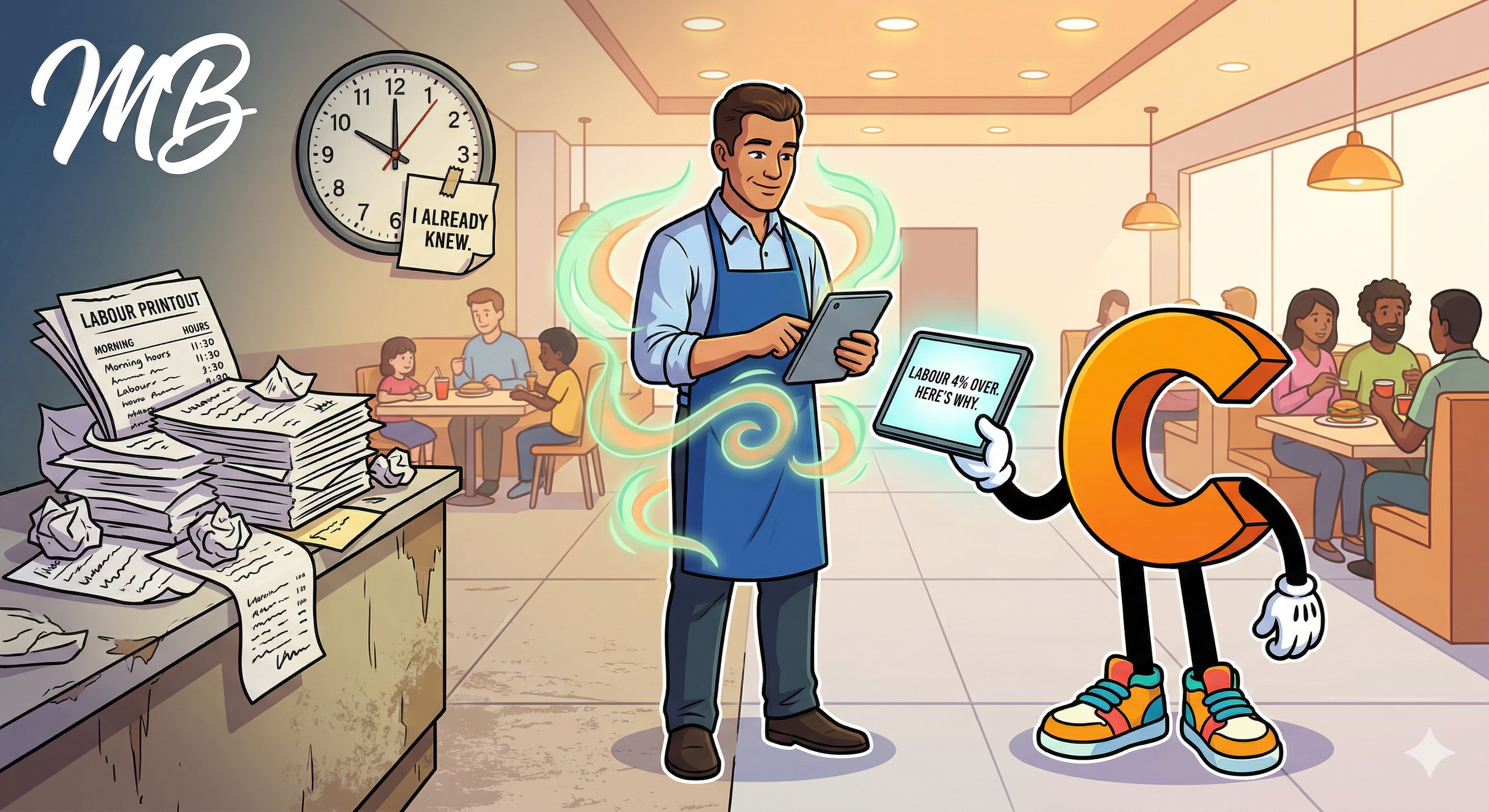
The operators I've worked with who are pulling ahead right now aren't the ones who've abandoned their gut feel. They're the ones who've given it better information to work with.
That's what good technology does in a restaurant. It doesn't replace the operator. It brief the operator — faster, more accurately, and across more variables than any morning meeting ever could.
The shift I nearly missed wasn't on the floor that day in New York. It was in how I was thinking about the relationship between experience and data.
Twenty years later, I'm still learning to read the room. I've just got better tools to help me do it.

What restaurant operators actually need from AI — and why most tools miss the point entirely
The AI tools being built for restaurants are mostly built by people who've never run a shift. They're designed for tech companies, repackaged for hospitality, and sold to operators who are too busy to notice the difference until they've wasted six months and a significant budget.
Here's what I've learned after 20 years operating and consulting in restaurants across four continents: operators don't need AI that's clever. They need AI that's useful. There's a meaningful difference.
What operators actually need:
Labour percentage is the number that tells you everything. If your labour is wrong, nothing else matters. What operators need is a tool that looks at their rota, their covers, their revenue — and tells them in plain English where the problem is and what to do about it. Not a dashboard. Not a report. An answer.
Weekly reporting consumes hours that Area Managers and GMs don't have. The average multi-site operator spends 3-4 hours per week producing reports that nobody reads in full. A well-designed AI prompt can do that in 60 seconds — and produce something sharper than the manual version.
Site performance comparison across a portfolio is where the real insight lives. Not averages — outliers. Which site is quietly underperforming? Which one has a labour problem hiding behind strong top-line revenue? AI is genuinely good at finding patterns humans miss in data they're too close to.

What most tools get wrong:
They're built for scale before they're built for usefulness. A tool that works for a 500-unit chain doesn't work for a 12-site operator — and the 12-site operator is where most of the real need is.
They require clean data. Restaurant data is never clean. Any tool that can't handle messy, inconsistent, multi-format data isn't a restaurant tool. It's a proof of concept.
They solve the wrong problem. Operators aren't asking for AI that predicts consumer trends or optimises their marketing funnel. They're asking for something that gives them their time back. Start there.
What I'm building:
I'm developing a set of practical AI tools specifically for restaurant operators — starting with a weekly ops report generator and a labour diagnostic tool. Both are designed to work with the data operators actually have, not the data they wish they had. Join the waitlist if you want early access.