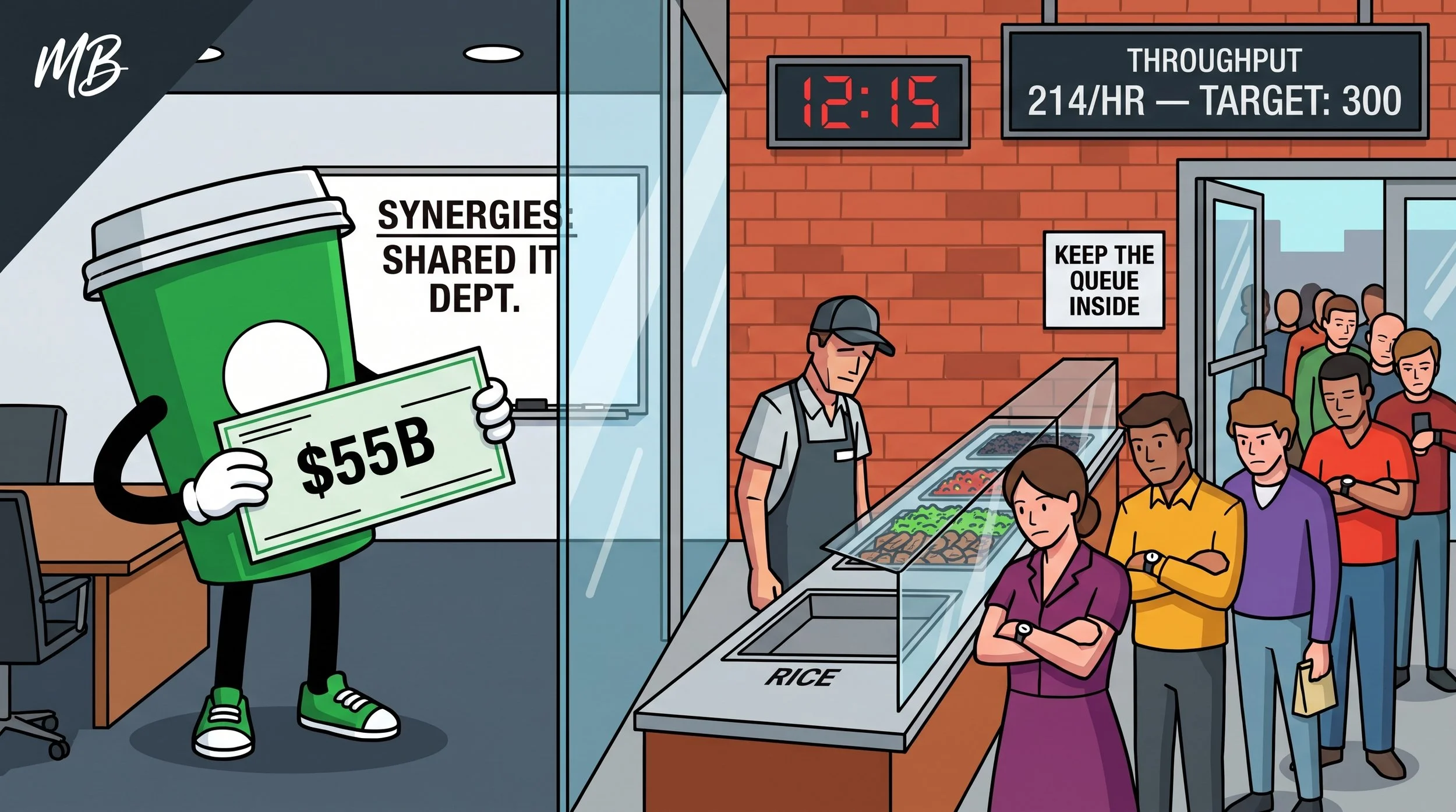
The front line is key. Turnarounds are won on the front line, not in the boardroom. Michael Baglieri
Part 1 of 3: The strategic rationale and the Niccol factor
I was on the floor of the New York Stock Exchange the day Chipotle went public in 2006.
Twenty years later, the man who rebuilt it might be the one to buy it.
Maybe.
Last week, the Financial Times reported that Starbucks has worked with advisers on a possible bid for Chipotle. Be clear about what that means. There are no talks and there is no offer. Chipotle says it hasn’t received a bid. Starbucks says it doesn’t comment on rumours and is “laser-focused” on its own turnaround.
So why write about a deal that may never happen?
Because the rumour tells us something true, whether or not anyone signs anything.
Two companies, trading places
When Brian Niccol left Chipotle for Starbucks in August 2024, most people saw a CEO move. In hindsight, it was a transfer of the one thing both companies needed most.
Since then, Starbucks shares are up about 20%. Chipotle’s are down about 45%.
At Starbucks, more customers are coming through the door. Transactions were up 4.2% last quarter. At Chipotle, same-store sales haven’t grown more than 2.2% in any of the last six reporting periods, and half of those were negative.
One brand found its operator. The other lost him.
Chipotle is a line business
I spent seven years at Chipotle and opened the New York market. If there is one thing I know about that business, it is this:
Everything comes down to the line.
The brand, the margin and the share price all depend on how many guests you get down the line between 12:00 and 2:00. When you hit your number, the restaurant prints money. When you don’t, nothing else you do will save the P&L.
When we opened New York, we knew the line had to pay Midtown rent. That meant chasing 300 transactions an hour.
The rule was simple: keep the queue inside the building. If more than five people were standing outside the front door, we knew the number of guests who looked at the line and walked away would triple. At some sites, like Bowling Green on a rainy day, the queue would wrap around the entire inside of the restaurant. That was fine. Inside meant they were staying.
You could feel the difference the moment you walked in.
When the line was jamming, the guests’ faces were full of smiles and anticipation for their moment at the front. When it was slow, you felt the tension before you saw anything: crossed arms, stern faces, people checking their watches. You dropped your backpack in the office and jumped into the kitchen to find the kink.
It was never a mystery. Someone had called out. Someone had fallen behind on rice. The dish area had blown up and there weren’t enough pans or spoons.
You don’t hit 300 an hour by asking people to work faster. You get there by removing every second that doesn’t need to exist.
So we changed the experience to fit the city.
We priced for speed. We reset every menu board price so that, once tax was added, the total landed on .25, .50 or .75. Cashiers only had to deal with bills and quarters. No fishing for nickels and dimes while the line backed up to the door.
We protected the line. We added a position whose only job was to keep the line stocked. Nobody serving a guest ever had to disappear into the kitchen to refill the steak. The crew’s attention stayed where it belonged: on the person in front of them.
We taught the guest our language. We trained customers to order the way we called it internally: “Burrito. Chicken. Black.” Before long, New Yorkers were ordering in our shorthand without thinking about it. Every order arrived in the sequence the line was built to make it.
We built for the orders you couldn’t see. Every New York site had a second make line. Back then it handled fax orders. Yes, fax. Today, that second line handles digital orders.
Managers checked the throughput numbers several times during each rush, and sometimes swapped positions after the first hour. Working Tortilla 1 through the full lunch rush is no joke. By 2:30 on a Friday, everyone was on the phone comparing results. If a site broke its throughput record, by 3:30 the crew was eating pizza or ice cream.
None of that was strategy. It was operations. And it worked because everyone in that building understood one thing.
The front line is key.
Anyone who has worked at Chipotle will smile at that line. It was a pillar of the culture. Everything else served the people on the line, and the people on the line served the guest.
Throughput is not part of the product at Chipotle. Throughput is the product.
Now look at the numbers through that lens
Average sales per restaurant in the second quarter slipped from $3.14 million to $3.10 million, even though sales across the company grew. Each restaurant kept 25.2 cents of every dollar, down from 27.4 cents a year earlier. Beef costs more. Labour costs more. And the line isn’t moving fast enough to pay for either.
That is not a brand problem. Customers still know exactly what Chipotle is.
It is a line problem.
What Niccol actually did at Starbucks
Here is the irony. Niccol didn’t fix Starbucks with a big strategic move. He fixed it on the floor.
He put more people in the stores. He cut the menu. He worked out how to get drinks into customers’ hands faster. That’s the unglamorous stuff every operator reading this knows by heart, and it worked.
The same logic applies at the counter. Baristas mark and call drinks in a set order: size, milk, shots and so on. The guest who orders in that same order saves a second or two at the till and is less likely to get the wrong drink. Starbucks’ app now does this automatically, because every mobile order arrives already in the right sequence. It is what our menu boards did in New York, rebuilt for a phone.
Which is exactly why a takeover doesn’t fix Chipotle.
A barista bar and a burrito line share almost nothing: different kitchens, different suppliers, different training and different peaks.
Both are high-throughput businesses, but the labour works in opposite ways. At Starbucks, most of the work happens at the moment of the order: the drink doesn’t exist until the guest asks for it. At Chipotle, most of the work happens before the doors open. The chopping, the marinating, the grilling and the guac are done hours ahead, so the line can assemble in seconds. One business is built at the till. The other is built in the prep kitchen at 8am. You can’t run both from the same playbook.
You cannot run Chipotle’s lunch rush from Starbucks’ headquarters. A holding company does not move a burrito down the line any faster.
Digital orders don’t change that. They’re now 38% of Chipotle’s sales, and most of them run down a second make line, the same idea we built for fax orders twenty years ago. But both lines draw on the same grill, the same rice and the same pans. When prep falls behind, both lines stall.
The parts that genuinely combine are real: leverage with landlords, Starbucks’ international partner network, and a shared app and back office. But none of them fixes the engine. About 97% of Chipotle’s restaurants are in the US, and every one of them still depends on getting people down the line at 12:15. Chipotle also already works with two of Starbucks’ biggest international partners. More on that in Part 3.
You don’t pay $55 billion for a shared IT department. That would be more than three times the biggest restaurant deal in history.
Watch what Chipotle’s board is doing, not what it’s saying
Two details are worth noticing.
First, Chipotle bought back $630 million of its own stock in the second quarter at a post-split average of $32.55 a share. That is almost exactly where the stock was trading when the deal report landed. The board has been voting with its own money on what the company is worth.
Second, in September Chipotle added the former CEO of KFC to its board. Before that, its chairman was the only director with real restaurant experience.
Those are the moves of a company that knows what it lost.
The real risk for Starbucks
For Starbucks, the danger isn’t the debt. It’s the timing.
This leak landed weeks before Niccol presents his first full-year outlook as a proven turnaround CEO. Every investor in that room will ask the same question:
If the coffee turnaround is working, why are we looking at burritos?
That question costs nothing to ask. Answering it poorly could cost Niccol the credibility he’s spent two years rebuilding.
What this means for the rest of us
Strip away the deal talk, and you’re left with a lesson every multi-site operator should take seriously.
The most valuable asset in either company isn’t the real estate, the app, or the loyalty programme. It is leadership that knows what the line should feel like at peak, and that won’t accept anything less.
Chipotle had that. It let it walk across the street.
You win turnarounds on the front line, not in the boardroom.
“The front line is key. Turnarounds are won on the front line, not in the boardroom.”
If you’ve run a line at peak, what’s the first thing you’d fix at Chipotle tomorrow morning?
Michael Baglieri