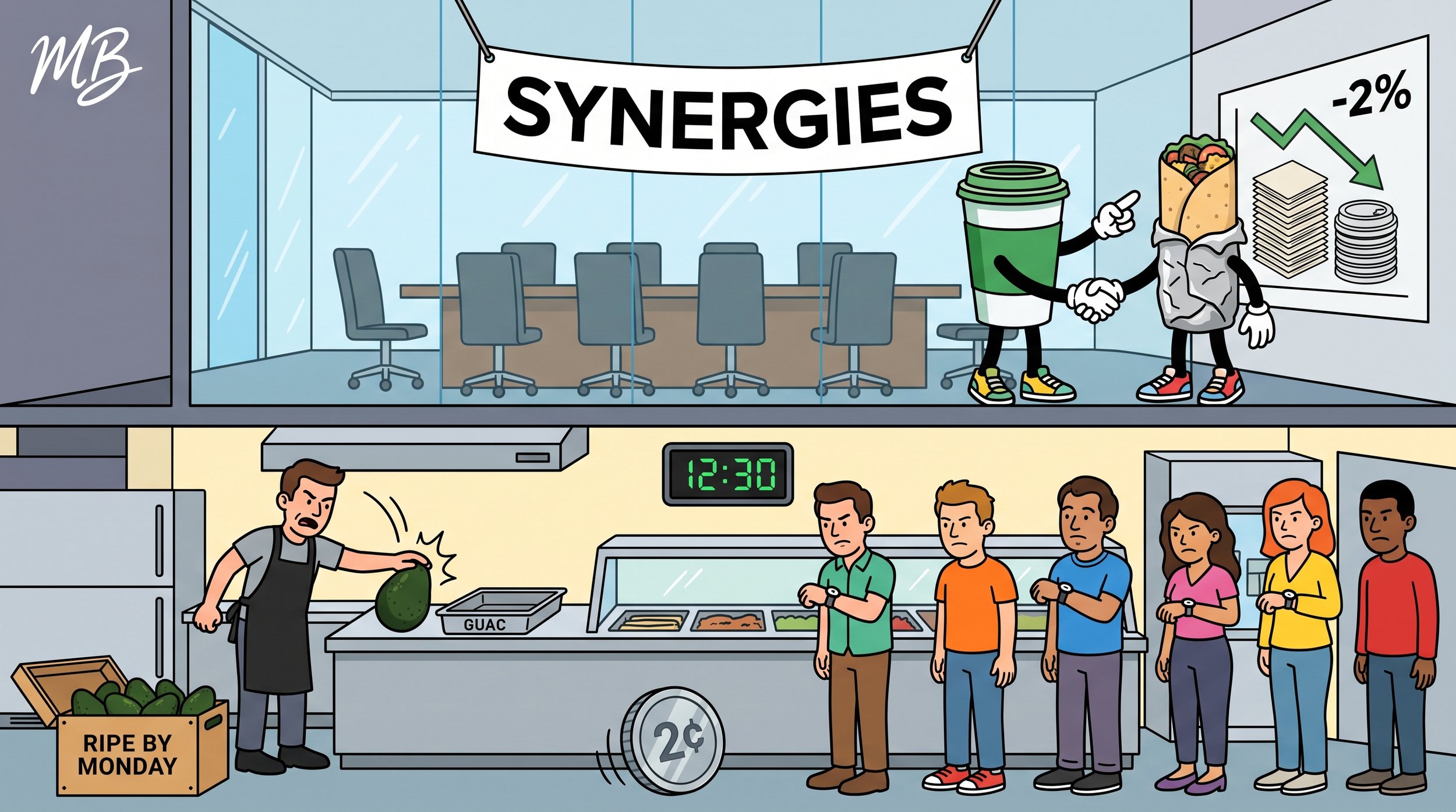
You don’t fix a margin problem with a bigger head office. You fix it at 12:30, on the line.” - Michael Baglieri
Part 2 of 3: The operational and unit economics reality check
In Part 1, I argued that Chipotle’s problem is the line, not the brand.
This week, I want to follow the money.
When bankers talk about a deal like Starbucks buying Chipotle, they talk about “synergies”. Operators should translate that word. It means: what gets cheaper, or what sells more, because two businesses sit under one roof.
So let’s go looking. Restaurant by restaurant. Dollar by dollar.
Start with one dollar
Take every dollar a Chipotle restaurant brought in during the second quarter.
About 30 cents went on food, drink and packaging, up from 29 cents a year earlier.
25 cents went on the crew.
After rent, utilities and everything else, the restaurant kept 25.2 cents. A year ago, it kept 27.4.
Two cents doesn’t sound like much. Across a business taking in more than $3 billion a quarter, it’s roughly $70 million every quarter that used to stay in the restaurants.
I know where those cents hide, because I used to chase them by hand. In my day, we built every restaurant’s weekly P&L ourselves in Excel. Three products drove more than half of our food cost: meat, dairy and avocados. And the fastest way to wreck a week was chicken. It’s fresh. If you got your sales forecast wrong or lost track of your stock, you binned two or three cases, and your food cost for the week was gone.
Thankfully, the tools are better now. The physics of fresh food isn’t.
So here is the only test that matters for any deal: does it put those two cents back?
What a merger can actually buy cheaper
Let’s be fair to the bull case. There are real savings.
Packaging. Cups, lids, bags, napkins. Both companies buy mountains of them. Combine the orders and the price comes down.
Technology. One app platform, one payments system, one data team instead of two.
Head office. Chipotle spent $176 million on general and administrative costs in the second quarter. That is the cost of running the company above the restaurants. Some of it overlaps with Starbucks.
Landlords. A company with 45,000 restaurants worldwide gets a better hearing than one with 4,200.
All real. Now let’s size them.
Say a combined company cut a quarter of Chipotle’s head-office cost. That’s roughly $175 million a year. Good money. But against a likely price of around $55 billion, that saving on its own would take more than 300 years to pay back.
And even if you made that cut, it wouldn’t touch the two cents. Head-office savings make the company’s overall numbers look better. They don’t put a penny back into the restaurant’s P&L. They hide the leak. They don’t fix it.
That leaves the other 30 cents: what goes on the plate. Packaging is the easy part, and the small part. The big part is beef, chicken, avocados, rice, beans and cheese. Starbucks doesn’t buy any of those at a scale that moves the price.
Coffee travels. Guacamole doesn’t.
Starbucks is built on a dry commodity. Green coffee is bought, roasted in its own plants and shipped in bags that last for months. Its supply chain is built for scale and distance.
Chipotle is built on fresh. Raw proteins. Produce. Avocados that go from rock-hard to brown in a few days. The skill isn’t buying cheap. It’s buying consistently, and turning it into food on the line before the first guest walks in.
In New York, most of our restaurants took three deliveries a week. Space was tight and volumes were huge. If your walk-in wasn’t nearly empty when the truck arrived, you had nowhere to put 20 cases of fresh chicken. Managing a fresh supply chain isn’t a purchasing exercise. It’s something you do in the restaurant, every day.
And sometimes, nature makes the decision for you.
In January 2007, a hard freeze hit California and wiped out large parts of the avocado crop. Our market received hundreds of cases from other sources, but they were as green as could be. Impossible to mash. Head office and our support team had done everything they could. Ripe fruit wasn’t coming until after the weekend.
I remember hanging up the phone thinking we might have to take guac off the menu.
Then I walked into a shiny new Whole Foods on Houston Street and found a mountain of ripe avocados. They had moved early on Mexican supply. I left a handwritten note for the head of produce and met him the next morning.
“How many cases do you need?”
“120.”
“I can give you 40 today. I’ll have 80 delivered here tomorrow.”
I spent that morning driving around Manhattan dropping off avocados like a yellow-taxi Santa Claus. The next day, all three New York area managers were at Whole Foods, loading up. We served guac all weekend.
That’s what a fresh supply chain looks like at street level. A barista who runs low on vanilla grabs another bottle off the rack. A burrito line that runs out of ripe avocados damages the guest experience..
Starbucks’ muscle in coffee gives Chipotle nothing on beef or avocados. And those are what’s squeezing Chipotle’s margin right now.
The labour model doesn’t transfer either
Niccol’s Starbucks turnaround added labour. He put more people in stores to get drinks out faster. It worked: North American same-store sales were up 8.1% in its most recent quarter, to June.
Chipotle’s crew already takes a quarter of every dollar. Headcount isn’t the problem. Deployment is.
At Chipotle, everything was married to the clock. Position charts. Food production schedules. Break times. Who’s on Tortilla 1 at 11:45, who’s on the grill at 12:15, who’s on break at 2:30. Get the timing right and the same crew does more. Get it wrong and no amount of extra labour saves you. That is management, shift by shift, and no parent company does it for you.
The risk nobody is pricing
Starbucks has a union. Its baristas rejected the company’s contract offer in April. Chipotle’s crews are largely non-union. Put both brands under one roof and organising at Starbucks becomes a conversation at Chipotle. That’s my reading, not a forecast. But any board would have to weigh it.
Loyalty: big numbers, different habits
Starbucks Rewards started the year with 35.5 million active US members, driving nearly 60% of US company-operated sales. Chipotle Rewards has 23 million active members after relaunching in April.
Put them together and you have a huge customer database. But a database doesn’t change a habit.
Starbucks’ most loyal guests come in several times a week, and many load money onto the app before they’ve bought anything. Chipotle’s regulars come in for lunch, once or twice a week. A free burrito offer in the Starbucks app might win a trial visit. It won’t turn a morning coffee habit into a lunch habit.
Frequency is earned on the line, one visit at a time.
The real estate idea is really a franchise idea
The smartest version of the bull case borrows from Yum Brands. KFC, Taco Bell and Pizza Hut run as separate brands but share real estate and back-office muscle. Niccol spent more than a decade at Yum. He knows that playbook better than anyone.
But Yum’s model works because it is almost entirely franchised. Franchisees run the restaurants; Yum runs the brands.
Chipotle owns and runs every one of its US restaurants. I’ve worked on both sides of that line: company-operated at Chipotle, franchised at Wingstop and Burger & Lobster. The difference is bigger than most people realise.
When you own the restaurant and you want to add labour to speed up the line, you have the right to do it. Almost the obligation. As a franchisor, you have to persuade a franchise partner to spend his own money because you believe a better guest experience will grow sales and pay for itself. That trust can take years to build. And with a large partner operating thousands of miles from head office, you often can’t see whether the change was actually made.
At Chipotle, I could walk from my East Village apartment to all eight of my restaurants. If I put a new hire on the chop station or on rolling, I could work alongside her for two shifts and make sure it worked. The feedback loop was instant. Our managers were in the dining rooms, talking to regulars every day. We were taught to act as if we owned the place, because we did.
That is why Chipotle’s culture and throughput were ever special. Applying the Yum playbook would mean either franchising Chipotle, which changes the business completely, or running two company-operated estates from one head office.
What about sharing sites? Starbucks drive-thrus and Chipotlanes chase the same suburban corners, and four in five new Chipotles now open with a Chipotlane. Shared site data and joint negotiations make sense. Putting two brands in one building doesn’t. Starbucks peaks at 8am and Chipotle at 12:30, but you would still need two kitchens, two crews and two sets of equipment.
You’d save on the car park.
The bill
Then there’s the cost of the money itself.
$55 billion is my estimate of the price once you add a normal takeover premium. Starbucks doesn’t have that in the bank. It already carries about $24 billion of debt.
If it borrowed half the price, and that debt cost around 6%, the interest would be about $1.6 billion a year. That’s close to what Chipotle earns in a full year. The rest would have to come from new Starbucks shares, which means every existing shareholder owns a smaller slice.
In restaurant terms, it’s like buying a second site with a loan whose payments eat all of that site’s profit, then hoping the savings on napkins make up the difference.
What actually puts the two cents back
Chipotle’s unit economics get fixed the way they always have.
Faster lines at peak. Prep that never runs short. Stock managed so nothing gets binned. Crews who know their positions. Managers who check the numbers mid-rush and move people where they’re needed. That is how a restaurant grows its sales without adding a single square foot.
None of that needs a $55 billion parent.
The synergies in this deal live in the head office. The money lives in the kitchen.
“You don’t fix a margin problem with a bigger head office. You fix it at 12:30, on the line.”
Operators: when your restaurants lose two cents of margin, where do you go looking first?
Next in this series: Part 3, the international playbook and Wall Street’s verdict.
Michael Baglieri