Part 3 of 3: The international playbook and Wall Street’s verdict
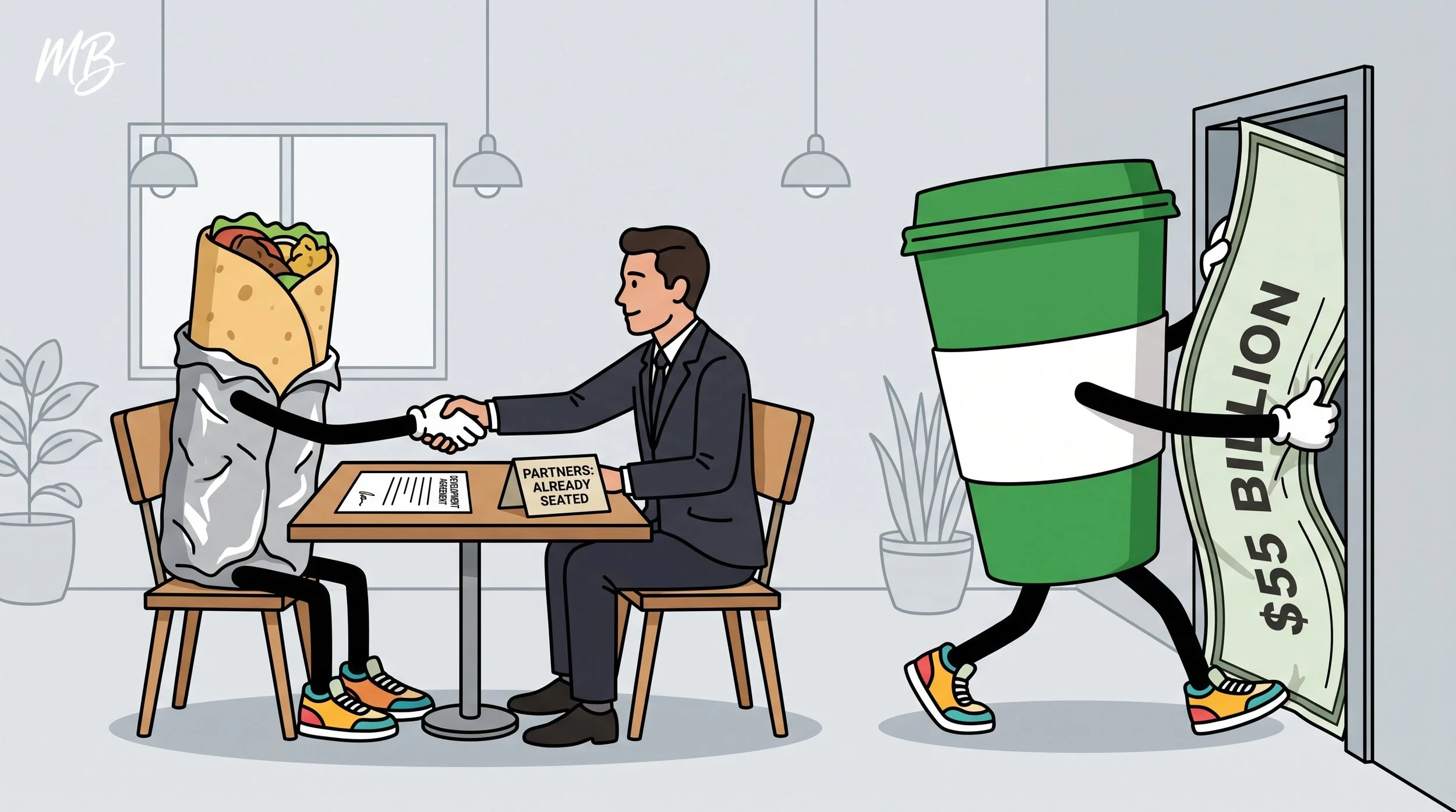
Chipotle already has development agreements with Starbucks’ key international partners, Alshaya and Alsea. No $55 billion is required.
In Part 1, I argued that Chipotle’s problem is the line. In Part 2, I argued that the synergies sit in the head office while the money sits in the kitchen.
That leaves the argument bankers lead with: international.
On paper, it’s the strongest case for the deal. Starbucks has around 41,000 stores worldwide and a network of operating partners in dozens of countries. Chipotle has about 4,200 restaurants, almost all in the US. Plug one into the other, and Chipotle goes global.
It’s a strong argument until you look at who is already at the table.
The partners are already in the room
Chipotle has signed three international partners in the last three years.
Alshaya, for the Middle East, in 2023.
Alsea, for Mexico, in 2025. Their first Chipotle opened in July near Monterrey, and Mexico City is planned for next year.
SPC Group, for South Korea and Singapore, in 2025. Korea is due to open later this year.
Now look at who runs Starbucks in those regions.
Alshaya has operated Starbucks across the Middle East for more than twenty years. Alsea runs Starbucks in Mexico, much of Latin America and parts of Europe.
In other words, the two most valuable relationships a takeover would “bring” to Chipotle are relationships Chipotle already has. It didn’t need a $55 billion deal to get them. It needed a development agreement.
And where Chipotle didn’t follow Starbucks, in Korea, it chose a different partner on purpose. SPC is the group that brought Shake Shack and Dunkin’ to Korea, and it knows how to launch American brands there.
There’s a deeper point too. Starbucks itself is handing more of its international business to partners. This year it sold control of its China business, around 8,000 stores, to the investment firm Boyu Capital, keeping 40%. The international “platform” a buyer would be paying for is increasingly a set of partner relationships. Partner relationships aren’t exclusive. Chipotle can sign its own, and it already has.
Chipotle’s real international problem
If partners and landlords were the barrier, Chipotle would already be global.
It isn’t, and it has had plenty of time. Chipotle opened in Canada in 2008, London in 2010, Paris in 2012 and Germany in 2013. More than fifteen years later, it has around 30 restaurants in Europe.
I had a front-row seat. In 2010, I was running operations at Chilango, a London Mexican brand, when Chipotle arrived.
Their first site, on Charing Cross Road, was a smart choice. It’s still open today. Then came a handful more in quick succession, mostly in the West End, on heavy rents and heavy key money. The moves into France and Germany stalled. Chipotle’s own European director said at the time that fast growth was “very risky”, and the next decade proved him right. By 2020, Chipotle had just eight restaurants in the UK, all in London.
The issue wasn’t the brand or the food. It was the approach. There was a “we can run this from the States” mentality, with very little local experience or relationships. Senior leadership changed every few years. It took years to adapt the kitchen for Europe, moving away from gas and fryers and into smaller sites. Meanwhile, homegrown brands had got there first. Tortilla had been open since 2007. I was across town, building Chilango.
Chipotle also became another wealthy client for London’s concierge economy: the agents, advisers and consultants who help American brands land here. I’m part of that economy myself, and there’s nothing wrong with it. When a company has a knowledge gap, paying to fill it is normal business. The mistake is renting local knowledge instead of building it.
So what changed?
Someone moved. In 2021, Brian Niccol, then Chipotle’s CEO, backed a fresh push into the UK. The following year, a Chipotle veteran of more than twenty years relocated from the US to London to run it. He admitted the UK business had drifted: the menu had fallen behind and the operation needed guidance. He fixed it on the ground. Ten openings followed in eighteen months. UK sales jumped from £17.9 million to £26.2 million in a single year. 2025 was Chipotle’s best UK year on record, and it plans to grow its UK estate by 20% this year.
Notice what the turnaround took. Not a bigger parent company. An experienced operator, living in the market.
A takeover run from Seattle would be the opposite instinct with a bigger cheque.
What actually decides whether a brand travels
I’ve spent most of the last fifteen years taking American restaurant brands abroad. In my experience, four things decide whether a concept travels. A partner network helps with only one of them.
1. The supply chain. At Burger & Lobster, I helped set up the supply chain to fly live Canadian lobsters and Australian beef to our franchise partners in the Gulf.
We opened in Jeddah during Ramadan. Once a live lobster comes out of its holding tank, you have roughly 48 hours. Most leave on flights from Boston Logan. Ours landed in Jeddah just as the evening prayer began, when the customs officers had gone home to break their fast with their families. We needed a stamp from the Ministry of Agriculture. They said they’d clear the shipment the following night. We told them the lobsters would start dying by 8am.
Mr. Ziad, our local partner, knew exactly who to call. The lobsters were released at 8:30 the next morning. I’ve never forgotten it.
Finding a partner is easy. Finding one with real local influence, overnight, during Ramadan, is priceless. And getting a perishable product to the restaurant, at the right quality, every single week, is the business.
Now apply that to Chipotle. Its menu depends on fresh avocados, specific chiles and proteins raised to its own standards. Avocados are expensive enough in California, where they actually grow. Add an 8,000-mile journey to the Gulf, and a fruit that has to arrive ripe, not rock-hard and not brown, and the cost of a single bowl of guac changes completely. That’s the problem Chipotle’s partners face in every new country, and Starbucks’ coffee buyers can’t solve it.
2. Re-engineering the operation. When I led Wingstop into Europe, the American model didn’t work as it was. We brought in new cooking technology and kitchen display screens, and stripped out every moment that didn’t add value. It was the same thinking as New York. There, we rounded prices to the nearest quarter. In London 2017, we went cashless.
Average ticket times, from order placed to food in the guest’s hands, fell by half. I led that work, and I was lucky to have ambitious partners who backed it. By early 2020, Wingstop’s CEO was telling investors that its “enhanced speed of service cooking platform” was part of the engine behind its international growth.
No head office hands you that. It’s built in the kitchen, by people who understand why the original model works and what has to change for a new market.
3. The cost of the box, and the time it takes to fill it. In the West End, Chipotle’s restaurants could be busy. Elsewhere, Londoners didn’t yet know the brand. Chipotle itself has said UK sites took longer to build their sales because of that. But the rent, the key money (the upfront premium London charges for a prime site) and the cost of a US-style kitchen arrived in full on day one. That gap between cost and sales is where international growth stalls. Closing it means redesigning the kitchen, rethinking the size of the site and building awareness one neighbourhood at a time. That work is done locally.
4. Then, and only then, the partner. This is the one area where Starbucks’ relationships could help. And as we’ve seen, Chipotle already has the partners that matter.
To its credit, Chipotle seems to have learned. When the Mexico restaurant opened, its business development chief said the focus was on “opening one great restaurant and learning”. That’s the right instinct. One great restaurant teaches you more than a thousand-store licensing network ever will.
Wall Street’s verdict
So what did the market make of it?
When the report came out, Chipotle’s shares rose as much as 8% during the day. Starbucks’ shares fell around 4% before recovering to close roughly flat.
Read those numbers like an operator reads a P&L.
If investors believed Starbucks was about to buy Chipotle at a normal takeover premium of around 30%, Chipotle’s shares would have jumped much more than 8%. A single-digit rise suggests the market sees roughly a one-in-four or one-in-five chance of a deal. That’s my estimate, but the direction is clear. The market doesn’t believe it yet.
Starbucks investors were more direct. A short dip, then a shrug. The message was: show us the turnaround first.
The sharpest question came from Seaport Research. If the savings aren’t the reason, what would Niccol do differently from the people running Chipotle today?
Any operator who has read this series knows the answer. He’d go back to the line.
The real verdict comes later this month
Starbucks reports its full-year results and gives its outlook for next year in the coming weeks. Chipotle reports around the same time.
Those two reports will say more about this deal than any rumour. If Starbucks shows its turnaround is still accelerating, a bid looks like a distraction from a winning plan. If Chipotle shows its traffic recovering, the price goes up and the argument for buying gets weaker.
Either way, the numbers that matter will come from restaurants, not from bankers.
What a smarter deal looks like
For investors reading this, here is the simplest way I can put it.
If the goal is international growth for Chipotle, the tool is a licence, not a merger. Chipotle is already using it.
If the goal is fixing Chipotle in America, the tool is an operator. Someone who knows what the line should feel like at 12:30, and won’t accept anything less.
Neither one costs $55 billion.
Closing the series
Over three weeks, I’ve looked at this deal from three angles.
The leadership: Chipotle’s problem is the line, not the brand.
The kitchen: the synergies sit in the head office, but the money sits in the kitchen.
The world: Chipotle already has the partners it needs. What it needs abroad is what it needs at home: great restaurants, one at a time, run by people who know the street they’re on.
Twenty years ago, I stood on the floor of the New York Stock Exchange and watched Chipotle go public. What made it worth buying then is what would make it worth buying now. Not the app, the head office or the global footprint.
The front line.
“If the goal is international growth, the tool is a licence, not a merger. If the goal is fixing Chipotle, the tool is an operator. Neither costs $55 billion.”
Investors and operators: if you had $55 billion and Chipotle’s problems, where would you spend the first dollar?
Michael Baglieri